River Trip - START
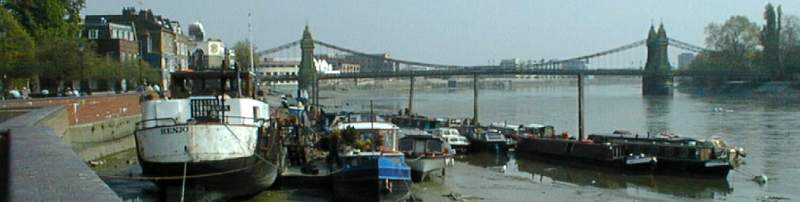
View from Lower Mall looking east at Hammersmith Bridge
SOUTH BANK
Towpath
The southern shore has a continuous towpath, lined by trees, extending from Barnes, passing Hammersmith Bridge, and on towards Putney. There are very few buildings along its length until it reaches the boat-yards at Putney. It provides spectator space to watch the annual Oxford and Cambridge Boat Race.
NORTH BANK
Chiswick Eyot
This unusual feature is the first of many small islands up-stream of Hammersmith Bridge.
Upper Mall
The riverside is lined by elegant houses and gardens. Part of the road is known as Chiswick Mall before changing its name to Upper Mall, within the London Borough of Hammersmith and Fulham.
Kelmscott House
Built in 1780, the house was lived in by William Morris from 1878. He died there on 3 October 1896.
Dove PH
Overlooking the pier is the beer-garden of this charming pub. It is said that 'Rule Britannia' was written in one of the upper rooms.
Hammersmith Pier
An old Port of London Authority (PLA) pier which is now in private hands and has been named 'Dove Pier'.
Furnival Gardens
The large open space was laid out on the land once occupied by Hammersmith Creek, the expansive mouth of a small stream called Sramford Brook. Until 1929 sailing barges entered the harbour to discharge their cargoes. The creek had been navigable up to King Street. The creek formed a harbour where the village of Hammersmith began. In 1936 the creek was filled in and the water was channeled into a culvert.
Lower Mall
Another line of interesting houses, some still used as residences while others are in use as two pubs and several sculling clubs.
Hammersmith Bridge
The first one, also a suspension bridge was opened in 1827. The present bridge was completed in 1887, designed by Joseph Bazalgette with the bridge supports, at either end, resting on the same foundations as the first one. It is the lowest bridge on the Thames with a very limited headroom at high tide. Either side of the bridge there are headroom-gauges on the river banks to assist navigation. The bridge is nine miles (14.4 km) up-river of London Bridge.
Harrod’s Depository
Built as a storage warehouse for the famous Knightbridge store, it stands on the south side of the Thames, a short distance down-river of Hammersmith Bridge. It was sold to developers in 2001.
London Wetland Centre
The centre opened in 2000. It is run by the Wildfowl and Wetlands Trust, based at Slimbridge, in Gloucestershire. Extending across 105 acres, the land at Barnes occupies the old site of four large water board reservoirs.
Beverley Brook
The brook enters the Thames under a small footbridge. It acts as today’s boundary between the London Borough of Wandsworth, on the southern side, and the London Borough of Richmond. Its name is said to be derived from words meaning ‘beaver stream’.
Duke’s Head PH
A large pub faces onto the Thames, at No 8 Lower Richmond Road, a short distance west of the Star and Garter.
Putney Pier
Originally the pier was built for the Port of London Authority (PLA)) and it remained under their control until 1965. The pier, which is a short distance west of Putney Bridge, is today used for the private offices of Livett’s Launches.
Star & Garter PH
The earliest date for a pub on this site is 1809. It was rebuilt in 1901 and its exterior has an Edwardian look to it.
This enormous pub looks out over the Thames. Its large size indicates that it was built for Victorian pleasure seekers who flocked to Putney for the day out, particularly on Bank Holidays and especially on the busy occasion of the Oxford and Cambridge Boat Race.
Fulham Football Ground
The ground is known locally as ‘Craven Cottage. The name goes back to 1780 when a house was first built for Lord Craven as a ‘cottage orné’. It was enlarged about 1805 but, in 1888, was destroyed by fire. It stood near the river, NW of the Bishop’s Palace.
Bishops Park
The long line of trees beside the river mark the site of a large park in which is to be found the Tudor buildings surrounding the quadrangle of the old Fulham Palace. It was, until 1973, the residence of the Bishops of London, an occupancy of over 800 years.
All Saints, Fulham
Standing in a large churchyard is the parish church of Fulham. The body of the church was rebuilt 1880-81 to designed of Arthur Blomfield.
Putney Bridge
The site of Putney Bridge was originally a ferry crossing going back to at least Norman times. As well as carrying people, there was also a horse ferry plying between Putney and Fulham. Since the tolls were collected on the Putney side, the crossing was always known as the Putney Ferry and when replaced by a permanent crossing it was therefore called Putney Bridge. In 1729 a wooden bridge was built on the site of the Putney Ferry by Cheselden, the King’s carpenter. It was described as ‘a crude wooden toll bridge’ and was dominated by the toll house which straddled it at the northern end. In 1884 the bridge was taken down and a new one in stone was built 1884-86, by Joseph Bazalgette. The wooden bridge aligned with Fulham High Street, but the new one was built further up-river, on a slightly different location. At the Putney end, it aligned with Putney High Street.
St Mary, Putney
There has been a church on the site since 1291. The 1836 church was badly damaged by fire, due to an arson attack, on the night of 6 June 1973.
Rebuilding did not start until nearly 10 years later and the restored church, with several modern features, was re-hallowed in 1982.
Putney Wharf Tower
The building started life in 1962 as ICL Tower, the headquarters of International Computers Limited (ICL). They sold the 16-storey tower in 1990 and it was finally vacated in 1997.
The developers, St George, with architects Patel Taylor, took the building back to its original concrete frame and added a semi-circular steel-framed extension. The building work was completed in 2003. It is now 85 flats, a hotel and two restaurants.
Boathouse PH
A new pub was opened in 2004, facing onto the river at Brewhouse Lane, Putney Wharf. The whole area had been redeveloped and the new pub was one of several restaurants and shops to be opened at the new location.
Swan Dock
Now in use as a nature reserve, this old dock was once a convenient to barges to unload cargo.
Fulham Railway Bridge
The girder bridge was erected 1887-89 by the London and South Western Railway. Apart from minor repairs, the bridge continued in use for over 100 years until it was refurbished 1995-97 for London Underground Limited. The bridge carries underground trains across the Thames. On the east side of the bridge is a pedestrian footbridge, linking Putney Bridge underground station, on the north side, in Fulham, with Deodar Road, on the south side, in Putney.
Wandsworth Park
It was opened in 1903 on a site beside the Thames. The 20 acre (8.1 hectare) park was previously market gardens and is now Crown land to prevent development on the site.
Wandle, River
The mouth of the Wandle lies to the east of Wandsworth Park. In its heyday a total of 56 mills on the river justified its title of ‘the hardest working river for its size in the world’. The river falls 125 feet (38 m) during its journey to the Thames, thus providing enough power for the water mills dotted along its length.
Ship PH
The pub occupies a site beside the Thames, immediately upstream of Wandsworth Bridge. As well as a dining area inside the building, there is a large beer garden right beside the water’s edge. The pub is beside a new riverside walkway that opened about 2003.
Hurlingham House
The house can just be glimpsed through the trees of the river bank. It was first built 1760 but wings were added to the house in 1797. The house is privately owned and belongs to the Hurlingham Club and Country Club which offers many sporting facilities. At one time it was the headquarters of London polo and international matches were played in the grounds between England and the USA.
Wandsworth Bridge
A five span lattice girder bridge, 18 feet (5.5 m) wide, of wrought iron was opened 1873 to a design by J H Tolme. It was a toll bridge. The bridge was purchased 1878 by the Metropolitan Board of Works and made free of tolls. It was reconstructed 1936-40 by E P Wheeler and F R Hions. The engineer was Sir T Pierson Frank. The second bridge on the site, it is a three span cantilever construction of steel, of 646 feet (197 m) long, between abutments, and 60.5 feet (18 m) wide between the parapets.
Battersea Creek
It is the mouth of the River Falcon which joins the Thames via tiny inlet beside a large apartment block. The line of the stream follows parts of today’s Lavender Road and Falcon Road as far inland as St John’s Hill, before extending south.
London Heliport
The site at Lombard Road, Battersea, started in 1959, making use of a jetty. The heliport was originally owned by Westland and later owned by Harrods. It is still in use, serving local businesses but also acts as a base for the London Air Ambulance, used by the Helicopter Emergency Medical Service (HEMS) and for Police Air Support Units.
Battersea Railway Bridge
Sited 5.6 miles (9 km) up river of London Bridge, it was erected in 1863 for the West London Extension Railway. It has three unique features. Firstly, it carries the only railway line to connect the north of England with the south and was used extensively during the Second World War to move armaments and munitions from the factories in the north to the South Coast. Today it still carries freight trains as well as passenger trains, running out of Clapham Junction, via north London. Secondly, it is the narrowest bridge across the river, having only two railway lines. Thirdly, it is the only bridge on the Thames not crossing at right angles to the river bank.
St Mary, Battersea
First mentioned in the Domesday Book, the church was last rebuilt 1776 to designs of Joseph Dixon. The position of the church is unusual, with the old sailing barges moored beside the churchyard which is the only one in inner London to extend to the river's edge. In 1782 the mystic poet and painter, William Blake, was married to Catherine Boucher, the daughter of a local market gardener. Turner often visited the church to observe the sunsets across the water and transfer them to canvas.
Montevetro
The site, which had been occupied by small factories, was cleared in 1998. A new development, designed by Marco Goldschmeid, of the Richard Rogers Partnership, was completed in 1999. When completed, the apartments sold for between £450,000 and £950,000. Goldschmeid himself bought one of them for his own home. The large block stands on a site immediately east and to the rear of St Mary, Battersea.
Chelsea Harbour
According to Pevsner, an ‘instant riverside town for the rich’ was erected 1986-89, with a hotel, shops and about 500 apartments. It was built on land around which had been the coal dock of the old Kensington Canal. Since that time, many more large apartment blocks have been added.
Chelsea Creek
It is the mouth of a stream known as Counter's Creek which rises near Kensal Green Cemetery and once flowed through Fulham. The stream acted as the boundary for the parishes of Fulham and Chelsea, and in 1820 was converted into the Kensington Canal, part of which is still in evidence at the end of the creek.
Lots Road Power Station
Built in 1904 beside Chelsea Creek, it used to supply electricity for the London Underground Railway. The power station was closed in 2002 and has been incorporated into a large housing complex.
Cremorne Gardens
In the 19th century, large pleasure gardens, used by Londoners and named after a previous land owner Viscount Cremorne, extended over 28 acres of land to the west of the houseboats now moored on the river. Famous balloon ascents were made from the gardens in 1829. After being occupied by commercial premises for many years, a small garden was opened in 1982 on part of the site featuring the original large wrought iron entrance gates which have been restored and painted their original white.
Lindsey House
The house, which stands at Nos 96-101 Cheyne Walk, was last rebuilt 1674 by the Third Earl of Lindsey who was the Lord Chamberlain to Charles II. It was later divided into separate houses. Marc Brunel, the engineer, and his son Isambard lived in one of them. Another occupant was Count Zinzendorf who used part of the building as the London Headquarters of the Moravian Bretheren whose burial ground may still be seen near the Kings Road.
House Boats
Large moorings are to be seen in front of Cheyne Walk. They are one of the few places on the Thames in Inner London where such moorings are permitted.
