River Trip - Chelsea Bridge onwards
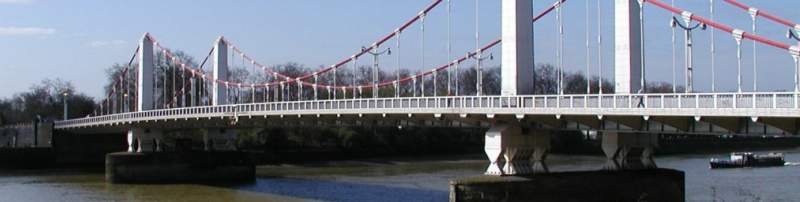
The first bridge on the site was designed by the engineer Thomas Page and opened 1858 as a toll bridge.
It was replaced by a second suspension bridge, a self-anchoring type of three spans, 698 feet (213 m) long, designed by G Topham Forrest and E P Wheeler, which opened in 1937.
Grosvenor Canal
To
the east of the railway bridge, steel gates control entry to what
remains of the Grosvenor Canal, formed in 1825 by converting the river
Westbourne into a canal. The venture was not a success and the canal
only reached to where Victoria Station is today. Little remains today
since, from 2003, a large housing development has been built on its
original southern end.
Chelsea Waterworks Company
The
large building, with a tall chimney behind it, is the Chelsea
Waterworks Company, established 1724 for the supply of better water to
Chelsea and Westminster. The company negotiated with the land owner, Sir
Richard Grosvenor, to lease a plot of land on which was built a
reservoir and a pumping station. The water itself came partly from the
Thames but also from the river Westbourne.
When opened in 1859 it was the widest railway bridge in the world, 132 feet (37.5 m) wide and 900 feet (274 m) long. It carries the Southern Region lines into Victoria Station.
Battersea Power Station
Famous more for its size than its beauty, the power station is one of the first examples of contemporary industrial architecture. It was designed by Sir Giles Gilbert Scott with four chimneys each 337 feet (103 m) high and opened 1934.
It ceased generating electricity in 1974 and was supposed to be redeveloped. Work has been spasmodic, with the building being sold on to several companies. At the time of writing little progress has been made.
Nine Elms Pier
This location is in use, less for the pier and more for moorings used by house-boats. It makes a pleasant ‘old world’ sight, contrasting with the more modern surroundings. The pier, at the end of Kirtling Street, is beside the Tideway Industrial Estate.
Effra, River
It can be seen discharging into the Thames, in the river bank just south of Vauxhall Bridge. The river rises at West Norwood but most of its course lies underground. It feeds the lake in the grounds of Belaire at Dulwich from where it used to flow along Croxted Road and is why Effra Road and Brixton Water Lane are so called. The last part of its course ran past St Mark, Kennington, before reaching the Thames.
St George Wharf (Development)
Large apartments blocks are situated beside the eastern end of Vauxhall Bridge, on the Lambeth side of the Thames. Started about 2001 the blocks were completed about 2005.
Dolphin Square
The large block of luxury residential flats, on the north side of Grosvenor Road, houses about 4000 people and includes a spacious garden, squash courts, a swimming pool and a restaurant. During the last World War General de Gaulle made the building his headquarters while organising the Free French Forces.
Pimlico Gardens
The gardens lie between Grosvenor Road and the Thames. In the gardens is a statue that commemorates William Huskisson who died in 1830 as a result of being run over by a steam train. He was the first person to be killed by a train.
Westbourne, River
At low tide the water from this ‘lost river’ can be seen discharging into the Thames. The stream, which rises at Hampstead, flows through Hyde Park, supplying water to the artificial lake known as the Serpentine. It crosses Knightsbridge, in an underground pipe, flows under Buckingham Palace and finally into the Thames at Pimlico.
Designed in cast iron with 9 equal arches and built 1811-16 it was first called Regent’s Bridge but its proximity to Vauxhall Gardens led to a change in the name. The present bridge, 760 feet (232 m) long, replaced the old one, which had become very hazardous, in 1906 and was the first bridge to carry trams across the Thames. Most people who cross the bridge have probably never noticed that the piers of the bridge are decorated with eight impressive bronze female statues. The figures represent important aspects of life at the turn of the 20th century. The second pier from the north bank, on the upstream side, is of particular interest, showing the figure holding a model of St Paul's Cathedral to represent architecture.
MI 6 Building
The imposing
offices were built for MI 6, completed in 1998 and designed by Terry
Farrell. They stand, overlooking the Thames, just north of Vauxhall
Bridge, on the Lambeth side.
White Hart Dock
Known as Doulton’s
Dock, because the company used it to unload materials and export their
pottery, the inlet is immediately south of Black Prince Road. The
navigable entrance under the Albert Embankment, remained unused after
Doulton closed down in the 1970s. Only the ornate main office building
remains to be seen. The river entrance is currently blocked by the Dutch
barge ‘English Maid’ (see lower picture), in use as a restaurant called
‘Thamesis Dock’.
London Fire Brigade Headquarters
It was opened in
1937 by George VI and houses the master control room from where
fire-fighting and other emergency services can be co-ordinated. On the
river, fire floats stand by to fight fires on vessels on the Thames or
in buildings alongside the Thames.
International Maritime Organisation
In 1982 the IMO
moved from Piccadilly into its new home on the Albert Embankment housing
a large conference hall and four large committee rooms with
simultaneous interpretation facilities for up to twelve languages. It is
the only United Nations specialised agency with its headquarters in the
United Kingdom. Every two years 122 member states meet to participate
in regulating world maritime matters, such as navigation, training,
safety at sea and sea pollution.
Seafarers' Memorial
The international
memorial to the world’s seafarers, past present and future, was unveiled
in 2001, standing in front of the IMO. The seven-metre high, ten-tonne
bronze representation of the bow of a cargo ship, with a lone seafarer
on the deck was made by the internationally renowned sculptor Michael
Sandle. The project was financed from a trust established in 1998 to
mark the 50th anniversary of the IMO.
Tate Gallery
It was built in 1890 on part of the site of the Millbank Penitentiary. In 1897 this gallery, along with 67 pictures, was presented to the nation by Sir Henry Tate, the sugar millionaire. The gallery houses modern art, sculptures by Rodin, Gill, More, Picasso and Epstein, as well as the paintings by British artists such as Turner, Blake and Gainsborough.
Tate Pier
A new pier was installed around 2000. The rather futuristic structure is designed to afford protection to passengers waiting for a river-bus. The pier is used to ferry visitors between Tate Britain and the ‘sister’ art gallery at Tate Modern.
Millbank Tower
Known also as the Vickers Building, it was completed in 1963 for the Vickers Company. It was one of the first high-rise office blocks to be built in London. Rising to 387 feet (118 m), it was then the tallest tower block in London. It is still in use as offices for several companies.
Thames House, Millbank
Constructed 1929-30, designed by Frank Baines, it was used by the Ministry of Fuel and Power occupy the building.
In 1994 it was sold to the British Government and is now the headquarters of MI 5.
The first bridge opened in 1862 on the site of Lambeth Ferry. This lasted until 1910 when, due to its poor condition, a weight limit was imposed and after a further 20 years it was pulled down. The present bridge was built further south of the first and opened 1932. The shapes of pineapples are depicted on top of the pillars beside the bridge to commemorate John Tradescant who first introduced the fruit to England.
St Mary, Lambeth
Although the church dates from only 1852, the tower is medieval and its style is typical of many to be seen all over the City of London before they were destroyed in the Great Fire. The small turret on top of the tower is the top of a spiral staircase up the side of the tower. The church is now used as a Gardening Museum which is particularly appropriate since a very famous gardener, John Tradescant lies buried in the churchyard. He lived in Lambeth, but went on many expeditions collecting plants and objects from all over the world. His house was known as ‘Tradescant's Ark’ and his name is perpetuated by the plant Tradescantia.
Another famous man buried in the churchyard is Vice-Admiral William Bligh, who died 1817. He was appointed to command the ‘Bounty’ on a voyage to the southern Pacific Ocean to obtain breadfruit plants for acclimatisation to the West Indies. Shortly after leaving Tahiti the crew mutinied and Bligh was cast adrift, with 18 of the ship's company, in a 23 feet (7.5 m) boat. In this they sailed a distance of 3,618 miles (5700 km) to Timor, a voyage which was an epic of skill, resource and courage.
Lambeth Palace
The riverside from this point to near Blackfriars Bridge was once the Manor of Lambeth. This was obtained in 1197 by the Archbishops of Canterbury and has been in their possession ever since, acting as their London home.
The buildings, called a palace, stand on the site of the old manor house of which the red-brick gateway, built 1490, and the Great Hall, built in 1660 with a hammer beam roof, can be seen from the river.
Evelina Hospital
It was founded in 1869 by Baron Ferdinand James de Rothschild. Ferdinand married his cousin Evelina in London in July 1865. The marriage ended tragically on 4 December 1866 when his wife, having been involved in a railway accident gave birth prematurely and both mother and baby died. Ferdinand decided to found a hospital in memory of his wife. It stood in Southwark Bridge Road, at the junction with Quilp Street, and closed in 1975. A new site was found and a new hospital, designed by Michael Hopkins, was built 2002-04.
St Thomas’s Hospital
Founded near the Borough High Street in 1213, the hospital developed along the north side of St Thomas's Street on a site now opposite Guy's Hospital. Closed by Henry VIII, it was re-founded by Edward VI in 1552. St Thomas's moved from the noise of the increasing road traffic, due to the new London Bridge, and the disturbance from the new steam trains arriving at London Bridge Station, to the peaceful surroundings of what were then open fields in Lambeth.
The long range of red-brick buildings, beside the Thames were erected in 1862. Most of them are still to be seen. The block nearest to Westminster Bridge was demolished in the 1960s. It was rebuilt and is covered in white tiles.
The hospital is probably best known for its connections with Florence Nightingale after whom a Training School was named. It was endowed by public subscription in memory of her services in the Crimean War.
River Tyburn
The Victoria Tower Gardens lie over the mouth of the Tyburn. The river rises at Hampstead and once flowed across land now occupied by Regents Park. It crossed Oxford Street, giving its name to the infamous gallows on the site of Marble Arch. After flowing near St James's Park, the stream divided into two sections, entering the Thames near the present site of the Victoria Tower and further north at Cannon Row. The triangle of land encompassed by water was called Thorney Island, becoming the site of Westminster Abbey.
Victoria Tower Gardens
The gardens opened in 1860 and contain two famous statues. One of Mrs Emmiline Pankhurst, pioneer of women’s suffrage in the 1920s. The other is the ‘Burghers of Calais’ by Rodin which commemorates six citizens who, in 1347, offered themselves as hostages to Edward III after he had tried to besiege Calais for nearly a year.
Westminster, Palace of
Due to its use, the building is often called the ‘Houses of Parliament’. Built as a palace by Edward the Confessor to be near Westminster Abbey it was completed in AD 1050 and continued to be used after 1066 as a palace and meeting place for the Court. As parliament developed, the Houses of Commons and Lords began to meet, along with the royal court.
In 1512 most of the palace was destroyed by fire. Only Westminster Hall and the Jewel Tower survived. Henry VIII acquired Whitehall Palace and lived there. He had new buildings erected for parliament at Westminster. They continued to meet in them until 1834 when there was another fire.
The present Gothic style buildings, designed by Sir Charles Barry, with interior designs by Augustus Pugin, were begun 1837 and opened by Queen Victoria. They included the House of Lords, opened 1847, the House of Commons, opened 1852, the Victoria Tower, completed 1860 and the famous clock tower, which began service on 31 May 1858, housing ‘Big Ben’, a large bell, weighing 13 tons, cast at the Whitechapel Bell Foundry, and probably named after Sir Benjamin Hall, then Clerk of the Works.
